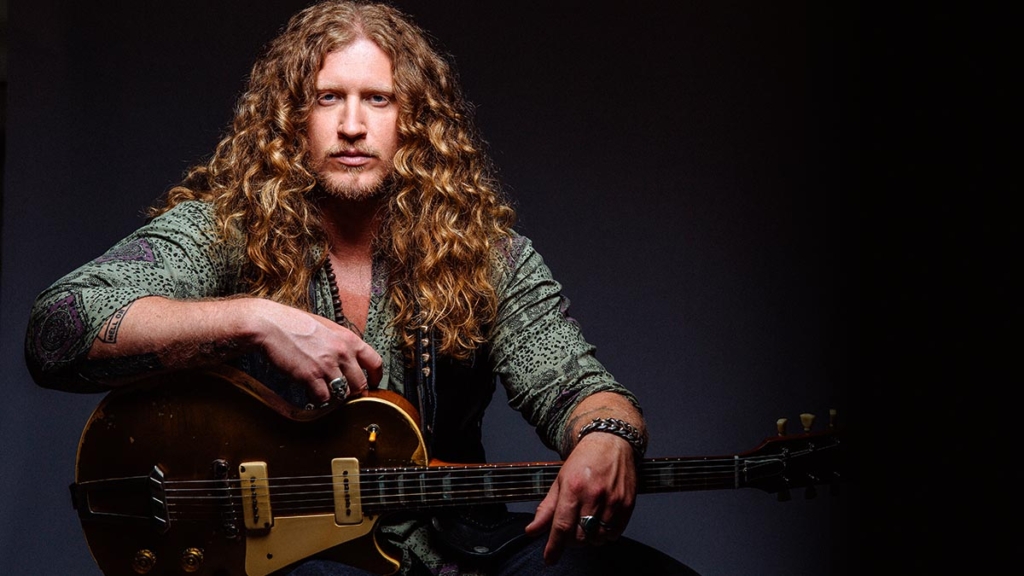
“Everything I do in life is left-handed, except for guitar playing… Using a plectrum never felt comfortable in my right hand”: Jared James Nichols on how he came up with his unique fingerstyle approach – and why it can make your playing more expressive
Hello, and welcom to my new column for Guitar World! Over the course of these lessons, I’ll discuss everything from my pick- and fret-hand techniques to my approaches to rhythm guitar and soloing, as well as some of my biggest influences.
The first thing I’d like to address is that I’m exclusively a fingerstyle player, and in my case it stems from the fact that I’m left-handed. Everything I do in life is left-handed, except for guitar playing. I think this is part of the reason why using a plectrum never felt comfortable in my right hand.
I realized early on that I needed to come up with my own way to play, and fingerpicking felt like the most natural approach. I use my thumb for downstrokes and my first three fingers for upstrokes.
There was one player in particular who inspired me the most in regard to playing fingerstyle, and that was blues legend Hubert Sumlin, who was known most notably for his work with Howlin’ Wolf.
When I heard Hubert play, it changed the way I approached the guitar. Then I heard Albert King, Derek Trucks and Mark Knopfler, all fingerpickers. All these players demonstrated the incredible range of sounds available when fingerpicking.
(Image credit: Future)
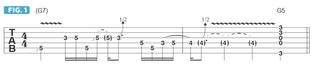
Figure 1 offers an example of a simple blues riff in G, based on the G minor pentatonic scale (G, Bb, C, D, F) played in 3rd position. While playing this lick, I use my fingertips to accentuate specific notes as I move through the phrase.
I use my thumb to strike the initial D note on the A string, and then my index finger to sound the F note, followed by the middle finger to sound G. I pull up on the string and snap it against the fretboard, which provides a percussive attack.
Snapping a string in this way serves to make a note really pop. Though the phrase is fairly simple, fingerpicking the notes allows me tremendous range in how they sound and feel. I can move my pick hand down by the bridge for a sharper attack and tone, or up by the fretboard for a warmer, mellower sound, and all points in between.
(Image credit: Future)
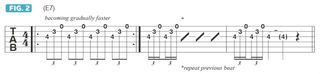
In Figure 2 I switch to E minor pentatonic (E, G, A, B, D) and demonstrate a “rolling” technique, in which I move across the top three strings picking thumb-index-middle consecutively.
As I repeat the three-note sequence, I gradually increase speed, moving from eighth-note triplets to 16th-note triplets.
(Image credit: Future)
As shown in Figure 3, I also utilize a little bit of palm muting (P.M.) to produce a more percussive attack. In Figure 4, I begin with the basic phrase and then expand on the idea.
(Image credit: Future)
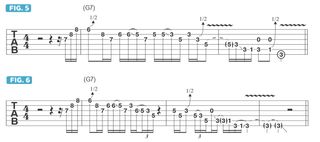
Figures 5 and 6 present longer phrases based on G minor pentatonic, for which I vary my pick-hand attack throughout, to add an expressive musical contour to the lines. As you play through these examples, try doing this to achieve different tonal qualities.
From the get-go, it’s been a remarkable year for guitar. There have been light-year leaps in tech, unexpected collaborations, genre boundaries have been shattered, new…
“Everything I do in life is left-handed, except for guitar playing… Using a plectrum never felt comfortable in my right hand”: Jared James Nichols on how he came up with his unique fingerstyle approach – and why it can make your playing more expressive
Report
There was a problem reporting this post.
Block Member?
Please confirm you want to block this member.
You will no longer be able to:
See blocked member's posts
Mention this member in posts
Invite this member to groups
Message this member
Add this member as a connection
Please note:
This action will also remove this member from your connections and send a report to the site admin.
Please allow a few minutes for this process to complete.




Responses